

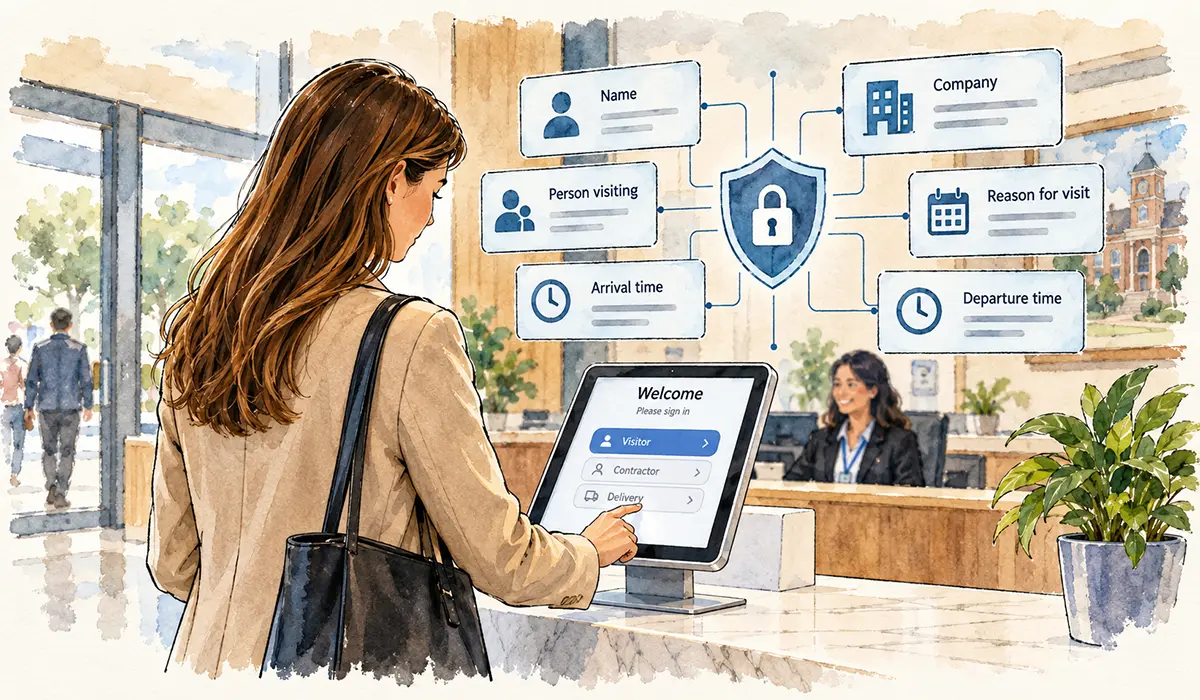
A visitor arrives at reception and is asked to sign in. Name, company, email, phone number, who they are visiting and why they are there can all quickly become part of the process.
It is easy for visitor registration to turn into a long list of questions simply because the technology allows it. But the better question is: what information do we actually need?
For most workplaces, the strongest visitor record is not the one that collects the most data. It is the one that collects enough information to support security, safety and operations without creating unnecessary privacy risk.
Start With the Basics
For many workplaces, a basic visitor record may include a name, company, person being visited, reason for the visit, arrival time and departure time.
That information helps establish who is onsite, why they are there and whether they have left. A digital visitor log can make those records easier to manage and provide a clearer picture of who is currently onsite.
The principle is simple: every extra field should have a clear reason for existing.
More Data Is Not Always Better
Collecting more information does not automatically create better security. Every additional piece of personal information also becomes something the organisation has to protect.
The U.S. Federal Trade Commission recommends businesses keep only information that serves a legitimate business need and avoid collecting sensitive personal information when it is not required. NIST describes this principle as data minimisation — limiting personal information to what is relevant and necessary for its intended purpose.
The question should not be “Can we collect this?” It should be “Why do we need it?”
Who Are They Visiting?
The host field provides important context. A visitor’s name tells the organisation who entered, while the host explains why that person belongs there.
It can also support automated host notifications, making the arrival process smoother for both visitors and reception staff.
Why Are They There?
The reason for the visit can help determine what process should follow. A simple category such as meeting, contractor, delivery, interview, supplier or event may be enough.
A client attending a meeting may only need a basic sign-in. A contractor may need to review site information or complete additional steps, while a delivery driver may need directions to a loading area.
This is why contractor management and visitor management often require different workflows, even when both groups enter through the same reception area.
Arrival and Departure Times Matter
Knowing when someone arrived is useful. Knowing when they left is just as important. Without a sign-out record, a visitor list can quickly become unreliable, particularly during emergencies.
OSHA advises employers to establish a method for accounting for visitors, contractors, suppliers and other non-employees during evacuations. A visitor record is therefore more than an administrative tool. It can also support emergency accountability.
Do You Need Contact Details?
Sometimes. Phone numbers or email addresses can be useful for appointment updates, pre-registration or emergency communication.
But if there is no operational reason to contact the visitor, collecting those details simply because they fit into the form may not be necessary. Again, purpose should determine collection.
When Should You Ask for Identification?
Some workplaces need stronger identity checks than others. A data centre, critical infrastructure site or high-security facility may reasonably require more verification than a general office.
CISA guidance recognises visitor identification and access controls as part of a broader risk-based physical security approach.
This is also where visitor management and access control begin to work together. Visitor management helps establish who someone is and why they are onsite, while access control can determine which areas they are permitted to enter.
Contractors Usually Need More Information
Contractors often require a different process from ordinary visitors because they may be performing work onsite. Depending on the workplace, that could include company details, type of work, site contact, induction acknowledgement, certifications and access requirements.
The important point is not to treat every visitor like a contractor — or every contractor like a normal guest.
How Long Should Visitor Information Be Kept?
Collection is only part of the privacy question. Retention matters too.
The FTC recommends retaining personal information only for as long as there is a legitimate business need.
That means visitor policies should answer two questions: What information do we collect, and when do we delete it?
Better Visitor Management Is About Better Information
There is no single visitor form that suits every workplace. An office, warehouse, school, construction site and data centre all face different risks.
The best approach is to start with the minimum information needed to identify the visitor and understand the visit, then add extra fields only where there is a clear operational, safety or security reason.
Platforms such as Visitor Management System by Teamgo can help organisations create tailored visitor workflows, collect the information relevant to each visitor type and maintain clearer records of who is onsite.
For many organisations, the core questions remain simple: Who are you? Who are you here to see? Why are you here? When did you arrive? And when did you leave?
That is often enough to create a useful visitor record without collecting more information than necessary.